Insights
Perspectives for Boards navigating complexity
Boards are required to make consequential decisions before certainty is available.
Therapia Consult publishes selected insights to support Chairs, Directors, and senior leaders in understanding governance, strategy, and organisational challenges at an enterprise level , particularly where issues are systemic, ambiguous, or poorly diagnosed.
- Clarified where problems truly sit before intervention
- Reduced unnecessary disruption and cost
- Strengthened Board confidence and judgement
- Reframed debates from opinion to system-level evidence
Most Enterprise Failures Are Not Execution Failures
Many organisations fail despite capable leadership, strong teams, and sustained effort. The issue is not execution competence, but enterprise incoherence — misalignment between strategy, structure, governance, people, and enabling systems.
Enterprise Coherence™ shifts Board attention from “why is this not working?” to “is the enterprise configured to work as a whole?” This distinction fundamentally changes how risk and intervention are understood.
Enterprise Coherence™ exists to inform Board judgement before intervention — not to prescribe action after complexity has already taken hold.
Frameworks Drive Action — Boards Need Judgement
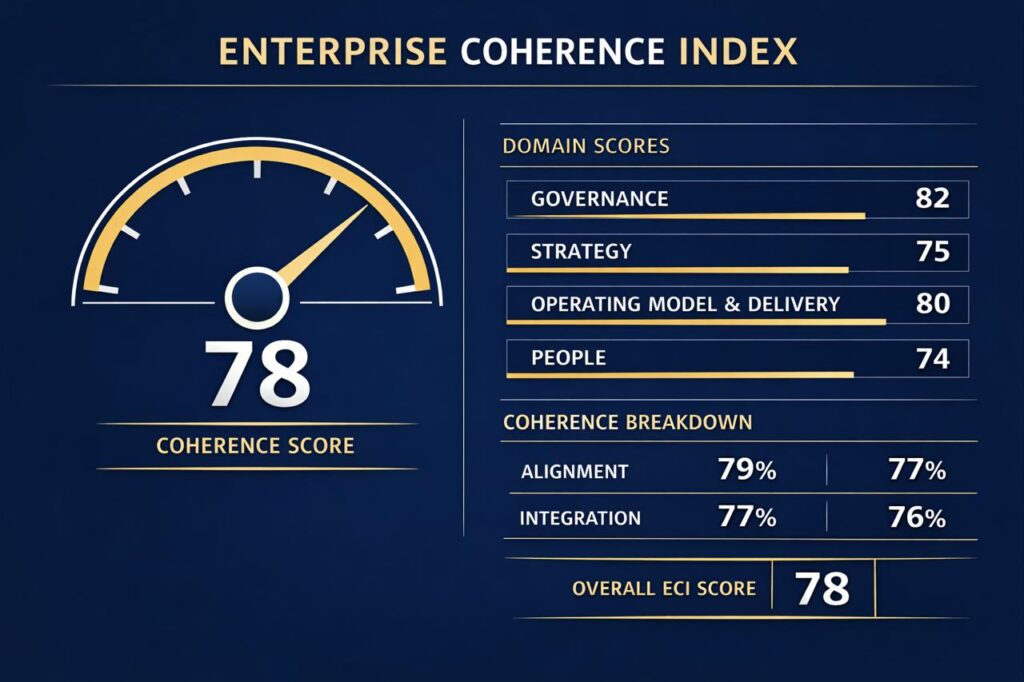
Traditional frameworks are designed to drive action. Boards, however, are accountable for judgement. Enterprise Coherence™ is not a framework to be implemented; it is a diagnostic lens applied to inform whether action is advisable at all. In complex enterprises, restraint can be as valuable as intervention, yet few advisory models support that discipline.
Enterprise Coherence™ exists to inform Board judgement before intervention — not to prescribe action after complexity has already taken hold.
Governance Risk Is Systemic, Not Structural
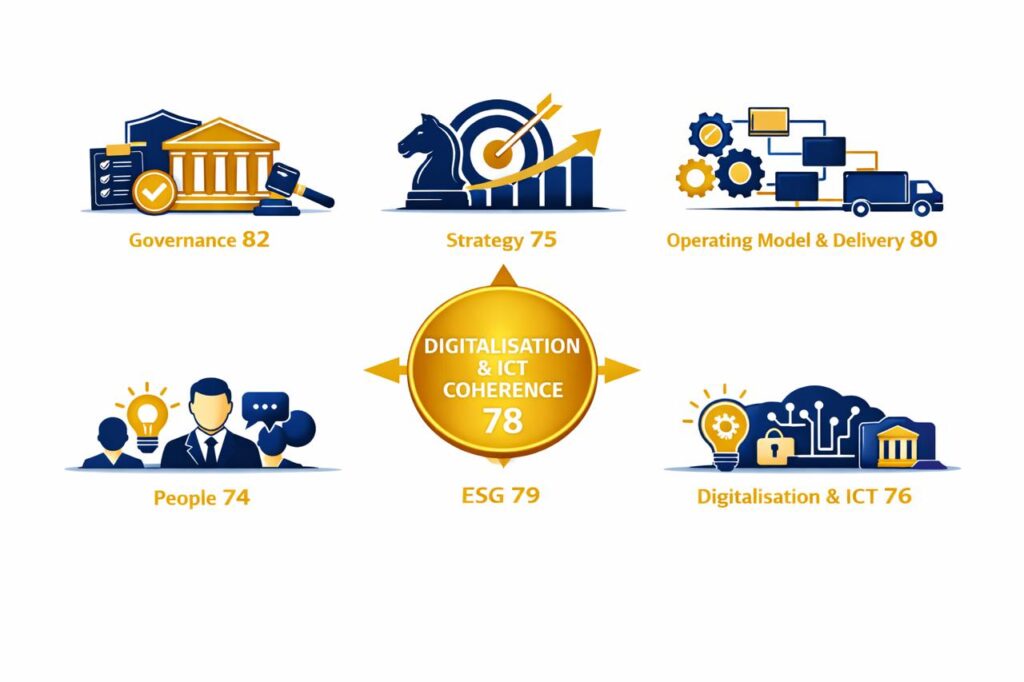
Many Boards respond to governance issues by adjusting structures, charters, or committees. Yet governance risk most often arises from how authority, escalation, and decision-making actually function across the enterprise. Enterprise Coherence™ examines governance as a living system, not an organisational diagram — revealing risks that formal structures alone cannot detect.
Enterprise Coherence™ exists to inform Board judgement before intervention — not to prescribe action after complexity has already taken hold.
Strategy Fails When It Is Governed Poorly, Not Worded Poorly
Boards frequently revisit strategy in response to under-delivery. However, failure usually originates in how strategy is prioritised, incentivised, monitored, and adapted, rather than how it is articulated. Strategic Coherence™ focuses on strategy as a system of choices and oversight — enabling Boards to distinguish execution failure from strategic incoherence.
Enterprise Coherence™ exists to inform Board judgement before intervention — not to prescribe action after complexity has already taken hold.
Operating Models Drift Long Before They Break
Operating models rarely fail suddenly. They degrade gradually through workarounds, role ambiguity, and coordination overhead. By the time performance breaks, control is already compromised. Operating Model Coherence™ allows Boards to see early structural drift, before it manifests as delivery failure or crisis escalation.
Enterprise Coherence™ exists to inform Board judgement before intervention — not to prescribe action after complexity has already taken hold.
Leadership Risk Is Often Structural, Not Personal
Leadership effectiveness is frequently framed as an individual issue. Enterprise Coherence™ recognises that many leadership challenges stem from unclear authority, fragmented accountability, or unrealistic load, rather than capability. Leadership Coherence™ enables Boards to govern leadership risk without defaulting to personal judgement or premature change.
Enterprise Coherence™ exists to inform Board judgement before intervention — not to prescribe action after complexity has already taken hold.
Digital Complexity Often Increases Risk Instead of Reducing It
Digital investment is commonly justified as a route to transparency and control. In practice, poorly governed digital ecosystems can increase opacity, dependency, and decision risk. Digital & ICT Coherence™ examines technology as a governance and decision system, not an IT portfolio — helping Boards understand whether digital complexity is serving them or undermining them.
Enterprise Coherence™ exists to inform Board judgement before intervention — not to prescribe action after complexity has already taken hold.
ESG Risk Lies in Misalignment, Not Intention
Most ESG failures do not arise from lack of intent, but from misalignment between commitments, data, accountability, and operational reality. ESG Coherence™ helps Boards test whether ESG ambition is governable and defensible — reducing reputational and regulatory risk without expanding bureaucracy.
Enterprise Coherence™ exists to inform Board judgement before intervention — not to prescribe action after complexity has already taken hold.
Transformation Fails When Timing Is Wrong
Transformations often falter not because strategy is flawed, but because the enterprise is not ready to absorb change. Transformation Readiness™ reframes transformation as a question of timing, load, and resilience — supporting Boards to pause, resequence, or reshape intervention rather than accelerate into failure.
Enterprise Coherence™ exists to inform Board judgement before intervention — not to prescribe action after complexity has already taken hold.
The Most Valuable Insights Are Often the Ones That Prevent Action
In high-pressure environments, momentum can become a liability. Enterprise Pulse™ provides Boards with early signals of strain, drift, or coherence erosion — allowing governance response before issues escalate. Sometimes, the most valuable outcome of insight is the decision not to act yet.
Enterprise Coherence™ exists to inform Board judgement before intervention — not to prescribe action after complexity has already taken hold.
Frameworks Drive Action — Boards Are Accountable for Judgement
Most frameworks are designed to mobilise management. Boards, however, are
accountable for judgement under uncertainty. Enterprise Coherence™ is not implemented or rolled out; it is applied as a lens that allows Boards to decide whether intervention is warranted in the first place.
Enterprise Coherence™ exists to inform Board judgement before intervention — not to prescribe action after complexity has already taken hold.
Governance Risk Is Systemic, Not Organisational
Boards often respond to governance issues by adjusting structures, committees, or charters. Yet governance risk usually arises from how authority, escalation, and challenge actually function across the system. Enterprise Coherence™ examines governance as a living system, not as a compliance artefact.
Enterprise Coherence™ exists to inform Board judgement before intervention — not to prescribe action after complexity has already taken hold.
Strategy Rarely Fails Because It Is Poorly Written
Most strategic under-delivery stems from misalignment between ambition, prioritisation, incentives, and oversight — not from flawed wording. Strategic Coherence™ treats strategy as a governable system of choices rather than a plan to be cascaded, enabling sharper Board oversight without rewriting strategy.
Enterprise Coherence™ exists to inform Board judgement before intervention — not to prescribe action after complexity has already taken hold.
Operating Models Degrade Long Before Performance Breaks
Operating models fail gradually through workarounds, role ambiguity, and coordination friction. By the time performance suffers, control has already eroded. Operating Model Coherence™ surfaces early structural drift that traditional transformation or restructuring initiatives typically miss.
Enterprise Coherence™ exists to inform Board judgement before intervention — not to prescribe action after complexity has already taken hold.
Leadership Risk Is Often Created by the System
Leadership challenges are frequently framed as individual capability issues. Enterprise Coherence™ recognises that many leadership failures are structural, caused by unclear authority, fragmented accountability, or unsustainable load. Governing leadership as a system avoids premature or misdirected change.
Enterprise Coherence™ exists to inform Board judgement before intervention — not to prescribe action after complexity has already taken hold.
Digital Investment Can Increase Risk When Governance Lags
Digital programmes promise transparency and control, yet often create fragmentation, dependency, and data mistrust. Digital & ICT Coherence™ reframes technology as a governance and decision system, helping Boards determine whether digital complexity is reducing uncertainty or amplifying it.
Enterprise Coherence™ exists to inform Board judgement before intervention — not to prescribe action after complexity has already taken hold.
ESG Risk Lies in Misalignment, Not Intention
Most ESG failures stem from gaps between ambition, accountability, data, and operational reality. ESG Coherence™ allows Boards to test whether commitments are governable and defensible, rather than assuming that disclosure equates to control.
Enterprise Coherence™ exists to inform Board judgement before intervention — not to prescribe action after complexity has already taken hold.
Transformation Fails More Often Due to Timing Than Design
Transformations often collapse under the weight of poor timing and overload, not flawed strategy. Transformation Readiness™ helps Boards assess whether the enterprise can absorb change without destabilising core performance — enabling restraint where restraint protects value.
Enterprise Coherence™ exists to inform Board judgement before intervention — not to prescribe action after complexity has already taken hold.
The Most Valuable Decision Is Often Not to Act Yet
In environments of pressure and momentum, action is often mistaken for leadership. Enterprise Pulse™ provides early signals of strain, drift, or coherence erosion, allowing Boards to intervene when it matters — not when anxiety demands it.
Enterprise Coherence™ exists to inform Board judgement before intervention — not to prescribe action after complexity has already taken hold.
Enterprise Coherence™ Is Not a Maturity Model — and That Is Intentional
Maturity models encourage benchmarking and progression, often detached from context. Enterprise Coherence™ deliberately avoids scoring enterprises against abstract end-states. It focuses instead on governability here and now, recognising that coherence is situational, not linear.
Enterprise Coherence™ exists to inform Board judgement before intervention — not to prescribe action after complexity has already taken hold.
More Data Does Not Mean Better Oversight
Boards are often overwhelmed with dashboards, metrics, and reports — yet remain surprised by outcomes. Enterprise Coherence™ shifts attention from data volume to decision relevance, clarifying whether information supports judgement or obscures risk.
Enterprise Coherence™ exists to inform Board judgement before intervention — not to prescribe action after complexity has already taken hold.
Independence Is a Governance Requirement, Not a Selling Point
Many advisory solutions depend on continuity of engagement. Enterprise Coherence™ is deliberately time-bound and independent, reducing the risk of dependency or agenda-driven analysis. Its value lies in clarity, not continuity
Enterprise Coherence™ exists to inform Board judgement before intervention — not to prescribe action after complexity has already taken hold.
Intervention Without Coherence Often Makes Things Worse
Well-intended interventions frequently amplify enterprise risk when coherence is weak. Enterprise Coherence™ exists to surface those conditions before action is taken, allowing Boards to avoid harm created by premature or mis-sequenced decisions.
Enterprise Coherence™ exists to inform Board judgement before intervention — not to prescribe action after complexity has already taken hold.
Restraint Is an Underrated Governance Capability
In complex systems, restraint is not inaction — it is disciplined governance. Enterprise Coherence™ legitimises restraint by grounding it in system-level insight, giving Boards the confidence to pause without appearing indecisive.
Enterprise Coherence™ exists to inform Board judgement before intervention — not to prescribe action after complexity has already taken hold.
Effective governance depends on the quality of questions Boards ask , before they decide to act.
These insights are intended to support that enquiry.